

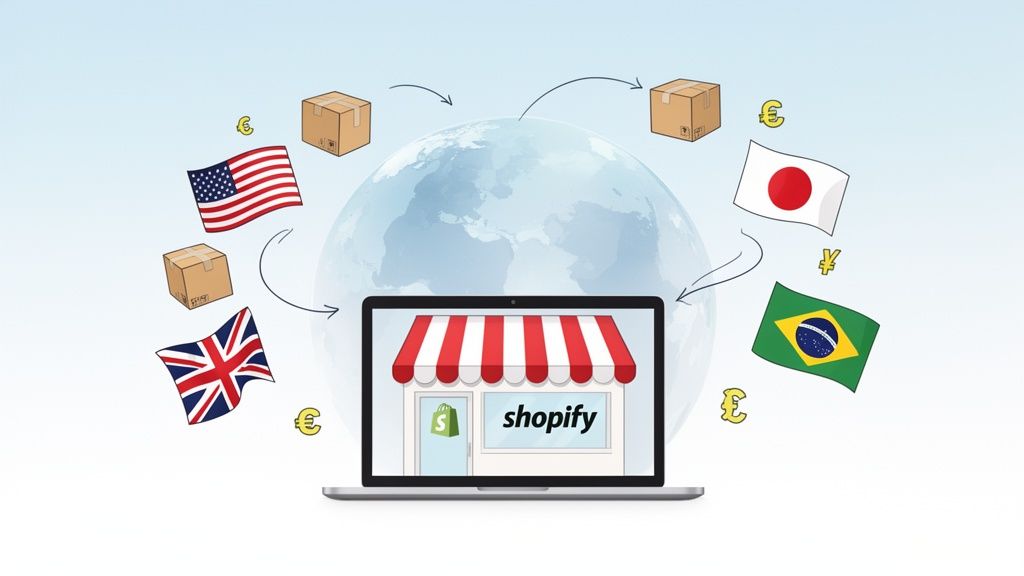
Selling internationally is one of the fastest ways to grow an online store. The moment you open your catalog to new countries, your potential customer base expands dramatically.
But cross-border commerce comes with a hidden challenge: unpredictability.
Unexpected duties. Surprise taxes. Carrier surcharges. Customs delays. Confusing delivery terms. If international shipping is not handled carefully, it can damage trust and reduce repeat purchases.
That’s why modern Shopify international shipping strategies focus less on simply “shipping worldwide” and more on delivering cost transparency and checkout confidence.
The Real Barrier to International Sales Isn’t Distance — It’s Uncertainty
Most customers are willing to wait a few extra days for international delivery. What they are not willing to accept is surprise costs at the door.
When shoppers see a product price and a shipping rate at checkout, they assume that’s the total cost. If they later receive a customs invoice or courier collection fee, the experience immediately turns negative.
Common outcomes include:
- Refused packages
- Chargebacks
- Negative reviews
- Reduced lifetime value
International expansion fails not because people don’t want the products — but because they don’t trust the final cost.
Understanding Landed Cost: The Foundation of International Shipping
Before optimizing international logistics, it’s important to understand landed cost.
Landed cost includes:
- Product price
- Shipping fee
- Customs duties
- Import taxes
- Handling and clearance fees
From a business perspective, calculating landed cost accurately protects margins.
From a customer perspective, displaying it upfront builds trust.
The most successful international Shopify stores treat landed cost as a visible checkout element, not a back-office calculation.
DDU vs DDP: Why Checkout Choice Matters
When shipping internationally, stores typically choose between two models:
Delivery Duties Unpaid (DDU)
The customer pays duties and taxes upon delivery.
Pros:
- Lower upfront checkout price
- Merchant doesn’t collect duties
Cons:
- Customer receives unexpected charges
- Higher refusal risk
- Negative delivery experience
Delivery Duties Paid (DDP)
Duties and taxes are calculated and collected at checkout.
Pros:
- No surprise charges
- Smoother delivery
- Higher trust
Cons:
- Slightly higher visible checkout total
Many international shoppers now prefer DDP because predictability outweighs marginal cost differences.
Some stores even offer both options, allowing customers to choose.
Why HS Codes and Product Data Matter
Accurate international duty calculation depends on:
- HS (Harmonized System) codes
- Country of manufacture
- Product value
- Destination country
Without correct classification data, duty estimates can be inaccurate.
For Shopify stores scaling globally, maintaining structured product data is no longer optional. It directly affects checkout transparency and profitability.
International Shipping Methods by Country
One-size-fits-all international shipping rarely works.
Different countries have:
- Different duty thresholds
- Different carrier reliability
- Different consumer expectations
- Different customs processing times
Smart international shipping setups often include:
- Country-specific shipping methods
- Region-based rate adjustments
- Conditional surcharges
- Exclusions for high-risk destinations
This approach allows merchants to grow internationally without exposing themselves to unpredictable losses.
The Profit Risk of Ignoring Duties at Checkout
When duties are not calculated at checkout, one of three things happens:
- The customer pays and feels frustrated.
- The customer refuses the parcel.
- The merchant absorbs unexpected costs.
None of these outcomes are sustainable.
Accurate duty and tax estimates protect both the business and the customer experience.
International Shipping and Conversion Rates
Many store owners assume international customers convert less because of higher shipping costs.
In reality, international conversion drops when:
- Shipping options are unclear
- Duties are hidden
- Checkout totals feel incomplete
- Delivery terms are confusing
When the total cost is clear and transparent, customers make decisions faster — even if the total is slightly higher.
Transparency increases confidence. Confidence increases conversions.
Multi-Carrier Strategy for Global Reach
International shipping often involves multiple carriers:
- Express services for urgent deliveries
- Economy services for cost-sensitive buyers
- Regional carriers for specific markets
Rate comparison and dynamic carrier selection allow stores to:
- Optimize shipping cost
- Reduce transit time
- Offer competitive international options
The more flexible the carrier setup, the more control the merchant retains over margins and service quality.
When Shopify Stores Should Upgrade Their International Shipping Setup
You may need a more advanced international shipping structure if:
- You ship to more than 3–5 countries
- You receive frequent customs-related complaints
- Customers abandon carts at international checkout
- You are unsure how duties impact your margins
- You want to offer DDP instead of DDU
- You sell products with varying duty classifications
At that stage, international shipping becomes a strategic growth function — not just a logistics setting.
Building a Sustainable International Strategy
Successful cross-border Shopify stores follow a structured approach:
- Maintain accurate product classification data
- Calculate and display duties transparently
- Offer region-appropriate shipping methods
- Use condition-based rules for flexibility
- Monitor duty thresholds and regulatory updates
- Optimize carrier selection by region
When these elements are in place, international shipping becomes predictable rather than risky.
If you’re evaluating structured solutions for handling duties, taxes, and flexible cross-border configurations within Shopify, the overview of shopify international shipping explains how landed cost logic and international rate control can be implemented directly at checkout.
Final Thoughts
International expansion is not limited by geography. It’s limited by clarity.
Customers are willing to buy across borders — but only when the full cost and delivery expectations are clear.
The stores that win internationally are not the ones that offer the cheapest shipping. They are the ones that remove uncertainty.
And in global eCommerce, clarity is a competitive advantage.
