Category: Trending Topics

Exposednews.co.uk your online source for the latest UK news stories and current events, ensuring our readers up to date with any breaking news developments.

  • The Impact of Global Geopolitical Changes on the South Caucasus: Challenges and Opportunities for Azerbaijan

    This article analyses the consequences of global geopolitical shifts for the countries of the South Caucasus, with a particular focus on Azerbaijan’s role in ensuring regional resilience, energy security, and logistical connectivity. It examines the main challenges arising from the Russia–Ukraine conflict, the growing U.S.–China rivalry, and escalating tensions between Israel and Iran. Special attention is given to Azerbaijan’s multi-vector foreign policy, its partnership with Turkey and the EU, and opportunities for post-conflict regional development. The article concludes by highlighting Azerbaijan’s increasing importance in shaping a new Eurasian architecture.

    In the 21st century, the South Caucasus remains a region where the interests of major global and regional powers intersect. Recent events – including the conflict between Russia and Ukraine, the intensifying confrontation between Israel and Iran, and the growing rivalry between the United States and China – are forming a new geopolitical reality that increasingly impacts Azerbaijan and its neighbours. Under these conditions, Azerbaijan demonstrates a model of balanced, multi-vector foreign policy that allows it to maintain resilience, enhance its international standing, and ensure internal stability and development.

    The conflict between Russia and Ukraine, which escalated sharply in 2022, has fundamentally changed the strategic landscape of Eurasia. The intensification of sanctions against Russia, Europe’s shift in energy policy, and the growing interest of the United States and the EU in alternative transport and energy routes have directly affected the South Caucasus. In this context, Azerbaijan has become a key partner in ensuring the region’s energy and logistics security. In 2022, a new memorandum of strategic energy cooperation between Azerbaijan and the European Union was signed, aiming to double gas supplies by 2027.

    The United States, traditionally active in the South Caucasus in the context of security and democracy, has increased its focus on the region through soft power tools and support for economic projects. Azerbaijan cooperates with American institutions in the fields of energy, combating transnational threats, and enhancing regional resilience, while maintaining dialogue with Russia, China, Turkey, and the Islamic world.

    China’s Belt and Road Initiative (BRI) plays a significant role in transforming Eurasian logistics. The South Caucasus, especially Azerbaijan, is becoming part of the Middle Corridor, linking China with Europe via Central Asia, the Caspian Sea, the South Caucasus, and Turkey. Amid disruptions to northern and southern routes, this corridor is gaining primary importance.

    Azerbaijan has invested heavily in the development of its transport infrastructure: the Baku Port in Alat, the Baku-Tbilisi-Kars railway, logistics digitalisation projects, and the creation of a special economic zone. This enables the country to become a key hub in global logistics, offering a reliable and secure alternative to traditional routes. The promising Zangezur Corridor, if fully implemented, will further strengthen Azerbaijan’s position as a bridge between East and West.

    Georgia remains a key logistics and energy partner for Azerbaijan. Major corridors, both railways (BTK) and pipelines (Baku-Tbilisi-Ceyhan, Baku-Supsa, and the Southern Gas Corridor), pass through Georgian territory. Close cooperation between the two countries in logistics, energy, and digital technologies enhances the region’s resilience and competitiveness amid global uncertainty.

    Political stability in Georgia creates favourable conditions for expanding transit capacity and attracting new investments. Joint efforts by Baku and Tbilisi to modernise infrastructure and reduce logistics costs ensure the smooth flow of goods and boost the importance of the Middle Corridor.

    Azerbaijan’s relations with Turkey deserve special attention. These ties are not only historical and cultural but are also reflected in strategic alliance, formalised by the Shusha Declaration (2021). Turkey has become not only a military and political partner of Azerbaijan but also a strong advocate in the international arena—at the UN, OIC, and the Organisation of Turkic States, as well as in matters of security and economic cooperation.

    Turkey’s geopolitical influence in Eurasia is growing. Amid the weakening of other players, Ankara is reinforcing its presence in the South Caucasus, Central Asia, and the Middle East. This creates favourable conditions for Azerbaijan as Turkey’s closest ally and simultaneously as an independent actor leveraging the Turkish vector to enhance its regional standing.

    For three decades, Armenia remained geopolitically isolated, becoming a kind of “logistical dead end” in the region. The absence of diplomatic relations with Turkey, closed borders, and the conflict with Azerbaijan restricted its participation in regional economic initiatives. However, following the 44-day war in 2020 and the full restoration of Azerbaijan’s territorial integrity, new opportunities have opened up in the regional architecture.

    If a comprehensive peace agreement is signed with Azerbaijan, Armenia will have a chance to integrate into transport and energy projects, including becoming part of East-West transit routes. Normalising relations with Azerbaijan and Turkey could bring Armenia economic benefits, investment, and infrastructure opportunities. Georgia’s example demonstrates how close cooperation with Azerbaijan can transform a country’s economy and international status.

    Azerbaijan remains a reliable energy supplier. The Southern Gas Corridor has become an essential element of Europe’s energy security. Amid reduced gas supplies from Russia, Baku has offered additional volumes and confirmed its readiness to engage in long-term energy partnerships.

    At the same time, Azerbaijan seeks to develop renewable energy projects. In cooperation with the UAE, Saudi Arabia, Turkey, and Europe, solar and wind stations are being implemented, opening prospects for exporting “green energy” to Europe. This aligns with global climate goals and strengthens Azerbaijan’s image as a responsible and modern player in the global energy architecture.

    The victory in the 44-day war of 2020 became a turning point in Azerbaijan’s history. The full restoration of the country’s territorial integrity and the establishment of sovereignty over Karabakh were recognised by the international community and strengthened national unity. Today, Azerbaijan is actively engaged in the reconstruction of liberated territories: roads, homes, schools, hospitals, universities, and airports are being built; electricity and water supply are being restored; and people are returning to their ancestral homes.

    Importantly, Baku is implementing these processes in line with international norms, focusing on sustainable development, environmental safety, and humanitarian aspects. This contributes to Azerbaijan’s positive post-conflict image and strengthens its diplomatic standing.

    Azerbaijan maintains a rare balance in foreign policy. While developing a strategic partnership with Turkey, Baku simultaneously sustains pragmatic and constructive relations with Russia, China, the European Union, the United States, Iran, and the Muslim world. This multi-vector approach ensures the country’s autonomy, flexibility, and resilience amid global turbulence.

    By positioning itself as a bridge between East and West, Azerbaijan is pursuing a “middle path” strategy, reinforcing its status as a sovereign state and a responsible international actor.

    Amid global transformations, the South Caucasus is becoming a space not only of challenges but of new opportunities. The intensifying rivalry between global powers, revision of transport routes, energy transitions, and the growing importance of regional resilience bring this geographically compact yet strategically vital region into the international spotlight.

    Against this backdrop, Azerbaijan demonstrates its ability to adapt effectively to the changing dynamics of world politics. The restoration of territorial integrity, active post-conflict reconstruction, renewable energy development, integration into the Belt and Road Initiative, cooperation with the EU and Turkey, and constructive dialogue with Iran, Russia, and the U.S. – all point to the maturity of the country’s foreign policy strategy.

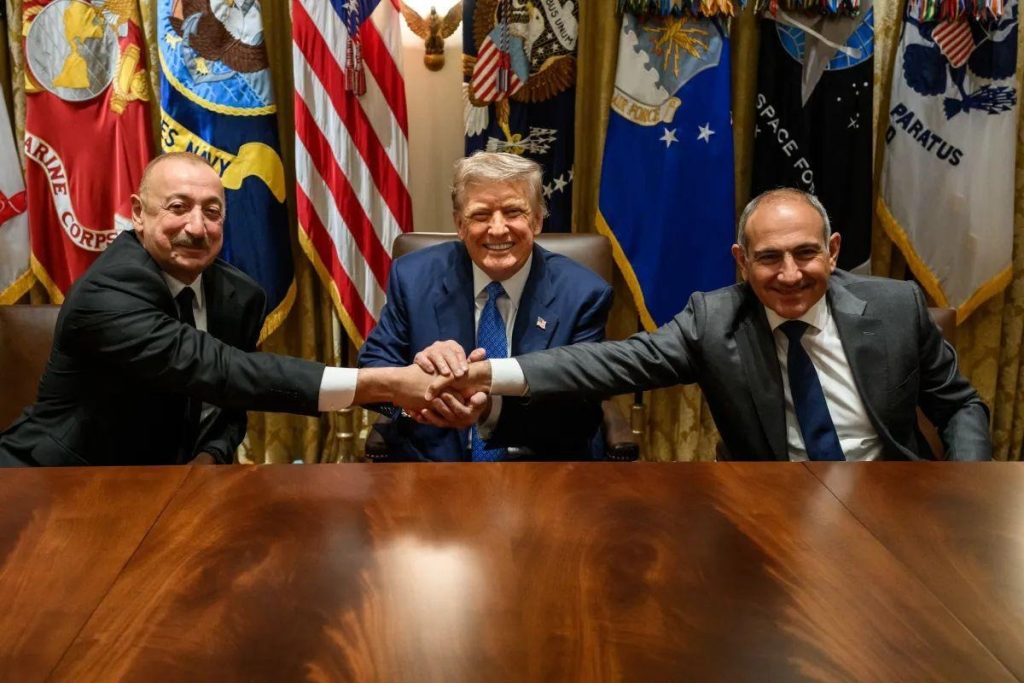
    This line of continuity – from strategic vision to its geopolitical implementation – is traced in the actions of Azerbaijan’s leaders. Heydar Aliyev, by implementing the “Contract of the Century” and ensuring the construction of the Baku-Tbilisi-Ceyhan oil pipeline, elevated the country to the global stage as a reliable energy supplier and the architect of a new energy map of Eurasia. This step laid a solid foundation for Azerbaijan’s economic independence and its weight in foreign policy. Decades later, Ilham Aliyev, building on this foundation, gave it a new – geopolitical and strategic – dimension. The Washington meeting on 8 August 2025, culminating in the signing of the Joint Declaration with Armenia, the initialling of the peace agreement, the joint appeal to close the OSCE Minsk Group, and the launch of the “Trump Route” (TRIPP) project, became a historic milestone. The United States, for the first time, consolidated its presence in the South Caucasus as a guarantor of stability and security, while the region itself gained a chance for lasting peace and integration into new transit and economic formats. This event, comparable in significance to the “Contract of the Century” but in the political-strategic sphere, definitively affirmed Azerbaijan’s role as a key architect of the change in the region’s geopolitical architecture.

    Azerbaijan is not merely reacting to changes but shaping them by building transport and energy corridors, forming a security architecture, and offering a balanced model of international conduct. Azerbaijan’s example shows how a mid-sized state can become a reliable partner for multiple power centres and act as a link between East and West, North and South.

    At a time when many regions face destabilisation, Azerbaijan offers an alternative—a path of development based on sovereignty, pragmatism, mutual respect, and a reasonable balance of interests. This makes it not only a stable regional actor but also a potential mediator, a stabilising force in a complex international environment, and a player of global relevance.

    Sidqi SHEVKET, Ph.D.Centre for Geopolitical and Legal Analysis: Transatlantic Perspective

  • Regulating the Unknown: Is the UK Financial Sector Ready for the Dawn of Automated Quantum Finance?

    Regulating the Unknown: Is the UK Financial Sector Ready for the Dawn of Automated Quantum Finance?

    LONDON, Authorities in the City of London face an unprecedented technological shift. Financial regulators are actively preparing for the complete integration of advanced computing and autonomous machine learning into national trading networks. Decisions made in microseconds will soon dictate the stability of the entire United Kingdom market ecosystem.

    For centuries, human brokers shouted orders across trading floors. Electronic tickers eventually replaced those voices. Basic computer code later automated simple market transactions. The financial sector is now abandoning those basic scripts entirely. Institutions and independent traders are attempting to outpace one another using deep analytical intelligence backed by radically new hardware architectures.

    Regulators openly acknowledge that their existing rulebooks cannot effectively manage this environment. The Financial Conduct Authority currently oversees rules written for human accountability and predictable software. Lawmakers must figure out how to police software that runs on complex probability mechanics and executes trades across global borders at the speed of light. Balancing core market safety with commercial progress remains the defining economic challenge for the current government.

    The Transition from Algorithmic to Quantum Processing

    Traditional algorithmic trading relies on straightforward binary logic. Software programs run on standard server farms, reading raw market data to execute a rigid set of instructions. A programmer writes code directing the computer to buy a specific equity if the price drops to a defined level. The machine will then sell that equity if the price hits a predetermined ceiling. This process works exceptionally fast, yet the underlying processor speed is constrained by basic sequential computing rules.

    Traditional processors must evaluate data requests one at a time. If a financial model requires the computer to analyze ten thousand different data points, the processor handles them in an incredibly rapid queue. The introduction of quantum mechanics rewrites that physical limitation entirely.

    Quantum computing logic utilizes qubits, which exist in multiple states simultaneously due to mechanical superposition. This allows a machine to calculate millions of conflicting outcome possibilities at the exact same moment. The predictive capacity expands exponentially. A machine learning program paired with this processing capacity can identify microscopic price discrepancies across hundreds of different asset classes without waiting for a queue to clear.

    Standard server farms take minutes to evaluate massive macroeconomic datasets against historical trends. A system built with superposition logic completes that identical computational task in fractions of a second. Investment firms building these models seek an absolute mathematical edge in anticipating market movements. Modern automated software rewrites its own operational parameters based on live data feeds. The program alters its bidding strategy depending on changing volume limits, completely removing human permission from the execution chain.

    The Physical Constraints of High-Speed Trading

    This race for computational speed previously reshaped the physical geography of the financial world. High-frequency trading firms spent billions to lay straight cables between data centers in different cities. Network engineers literally mapped the fastest possible route through mountains to ensure fiber optic lines did not curve, because every millimeter of physical distance added measurable latency to a financial transaction.

    When fiber optic networks proved too slow for elite algorithmic firms, companies began erecting massive microwave transmission towers across the English Channel. Microwaves travel through the air slightly faster than light travels through glass cables. Financial organizations spent vast sums to shave single digit milliseconds off their trade routing times between London and Frankfurt.

    Even single milliseconds are becoming obsolete metrics. The deployment of deep automated intelligence means machines anticipate market actions before data formally prints on public tickers. Systems ingest social media sentiment, shipping manifest updates, and weather patterns to execute massive capital movements before retail news outlets even report an event. This compression of time introduces massive systemic risk to the broader economy.

    The Threat of the Flash Crash

    The primary fear among regulatory bodies is a scenario where competing algorithms engage in a runaway feedback loop. If one machine detects high risk and starts dumping assets, a competing machine might read that sudden volume as a negative market signal and begin to sell as well. This cascading reaction could drain liquidity from national equities in an instant.

    The American market survived a severe warning in May 2010. The original Flash Crash wiped out roughly one trillion dollars in market value in less than forty minutes. That catastrophic drop started when basic automated systems reacted wildly to large sell orders. Investigations eventually traced a significant portion of the instability to a lone trader in Hounslow operating a modified software program from his bedroom. He used a tactic known as spoofing to flood the network with fake sell orders, tricking other algorithms into forcing the price down.

    That specific event happened on primitive binary networks. A modern error in an autonomous software parameter could trigger a catastrophic market sell-off before a human operator registers the anomaly on their monitor. Circuit breakers exist on major exchanges to halt trading during sudden statistical drops. Lawmakers openly question whether existing circuit breakers can pause a market reacting at multi-dimensional processing speeds.

    Retail Trading in the Institutional Arena

    Historically, only top hedge funds and massive investment banks possessed the capital to deploy high-frequency systems. Server access was prohibitively expensive. Software development required dedicated teams of elite quantitative mathematicians working in extreme secrecy. That historical exclusivity has almost entirely completely eroded across the City of London and beyond.

    Everyday investors now hold direct access to sophisticated predictive modeling. Independent software developers brought institutional logic directly to the broader public, completely bypassing traditional financial gatekeepers and corporate brokers. A user operating a Quantum AI platform can now manage automated strategies across digital asset markets and traditional equities markets without ever placing a call to a human advisor.

    This democratization shift permanently alters the balance of market power. Retail participants deploy software that analyzes global market trends, monitors sentiment data, and calculates pricing discrepancies entirely automatically. A retail trader sitting at home with a laptop accesses analytical calculation volumes that rival major banks from a decade ago.

    Regulators previously focused oversight strictly on large institutional desks. Now, government agencies must account for millions of individual accounts executing highly advanced, machine generated orders from personal devices. The volume of autonomous requests hitting the exchanges makes auditing individual intent incredibly difficult. The cryptocurrency sector amplifies this specific challenge significantly. Digital asset exchanges operate twenty four hours a day. Retail algorithms trade continuously. They never sleep, and they cross international borders without friction.

    The Regulatory Catch-Up Game

    The Financial Conduct Authority currently relies on the principle of explainability. If a broker makes a suspicious trade, an investigator can interview the broker and demand the rationale behind the transaction. Regulators apply this same logic to basic computer coding. Investigators can request the source code, read the specific line that triggered a mass sell-off, and determine if the code violated market manipulation laws.

    Deep machine learning models destroy this standard investigative approach. Neural networks operate inside a closed procedural box. The programmers feed the system raw data and assign a goal, such as maximizing a specific margin. The software then builds its own pathways to achieve that highly specific goal. If a deep learning model executes a trade that destabilizes a currency pair, the original programmers might not be able to explain how the machine reached its decision.

    This lack of transparency terrifies institutional watchdogs. You cannot fine a line of code. You cannot issue a legal subpoena to an autonomous concept. If an automated system commits an act that resembles illegal front-running, the legal liability remains entirely unclear. Courts must decide whether the software developer, the retail user, or the physical exchange bears responsibility for an action the machine chose independently based on probability mathematics.

    Step-by-Step Security: How a Trade Executes in an Automated Environment

    Understanding the regulatory anxiety requires tracking exactly how a modern autonomous trade unfolds behind closed doors. The entire process occurs faster than human physical perception.

    First, the software ingests raw information. The machine monitors structured data like official stock prices alongside unstructured data like global satellite imagery of crop yields. It assigns a numerical confidence rating to this collective information.

    Second, the system simulates risk. Instead of looking at historical charts alone, an advanced model runs thousands of simulated futures based on the data ingested moments prior. It determines the probability of a rival institution holding a massive hidden position.

    Third, the model routes the request. A standard retail broker sends an order to a central clearing house. An advanced automated system splits the single order into hundreds of microscopic child orders. The program scatters these child orders across multiple international exchanges to hide its true intentions from competing diagnostic monitors.

    Fourth, the system executes and verifies. The micro orders fill in scattered bursts. The algorithm immediately sweeps the results back together, recalculates its exact margin position, and begins the ingestion phase again for the next trade. Human regulators attempt to monitor this four step dance using reporting software that relies on end of day accounting figures.

    Building Frameworks for the Future

    Industry leaders and government agencies are testing heavily restricted legal frameworks. The Bank of England alongside the FCA manages testing sandboxes. These isolated digital environments allow developers to test live autonomous software against simulated market conditions. Authorities monitor the output to spot dangerous behavioral loops before the code receives permission to touch the actual economy.

    Politicians are also debating the mandated implementation of algorithmic kill switches. A kill switch forces any autonomous trading program to carry a hardcoded mechanism that instantly severs the software from market access if it begins losing money too quickly or generating excessive order volumes. Strict latency requirements would mean the kill switch must trigger independently of a human supervisor pressing a button.

    European regulators updated the Markets in Financial Instruments Directive to force algorithmic transparency, requiring firms to tag computer generated orders clearly in the shared ledger. The United Kingdom is exploring similar local tracing requirements. Mandating technical architecture is a massive intervention. Small development firms argue that forced compliance rules inherently favor massive banks that can afford to hire armies of internal compliance lawyers.

  • Burnham Inherits £4.7bn Funding Black Hole in Starmer’s £298bn Defence Swan Song

    LONDON — Outgoing Prime Minister Keir Starmer has officially unveiled his long-delayed £298 billion Defence Investment Plan (DIP), triggering a massive political row by leaving nearly a third of the new £15 billion funding lift completely unaccounted for.

    The strategy, which pushes UK military spending to 2.7% of GDP by 2030, has been heavily criticized by political insiders who claim Starmer has left a “delayed-action poison pill” for his likely successor, Andy Burnham.

    An ‘Unexploded Bomb’ for the Next Budget

    While Starmer used his final major policy announcement to pledge a “generational transformation” of the British military, Treasury documents revealed that £4.7 billion of the newly announced cash injection remains totally unfunded.

    The shortfall means Andy Burnham will be forced to identify billions in cuts or fresh revenue during his very first budget. Allies close to the Greater Manchester Mayor have reportedly reacted with fury, with one senior political source likening the surprise financial gap to an “unexploded bomb.”

    The bitter Whitehall row over the budget previously forced the resignation of former Defence Secretary John Healey. His successor, Dan Jarvis, managed to pull together an extra £1.5 billion from the Treasury in last-minute negotiations, but it wasn’t enough to prevent a massive multi-billion-pound deficit from being rolled onto the next administration.

    Nuclear Submarines and Drone Warfare Prioritised

    The newly published DIP maps out the UK’s military priorities over the next four years, significantly dialing back legacy hardware to fund next-generation autonomous tech.

    • £47 billion for nuclear modernization: Funding the Dreadnought submarine programme to replace the ageing Trident fleet, alongside the trilateral AUKUS project.
    • £8.6 billion for stealth jets: Developing the Global Combat Air Programme (GCAP) alongside Italy and Japan, plus £1.1 billion to extend Typhoon fighter lifespans.
    • £5 billion for autonomous systems: A massive cash injection for air, land, and underwater drone networks designed to operate alongside frontline soldiers.

    To pay for the immediate portion of the plan, the government is slashing capital budgets across Whitehall by 1%, selling off state assets, and halting or delaying key domestic road and green energy infrastructure projects.

    Starmer Warns Against ‘Defence Bonds’

    Before stepping down, Starmer used a press conference at a Berkshire drone manufacturer to explicitly warn Burnham’s camp against issuing specialized state bonds to cover the missing billions.

    “Defence bonds are just borrowing by another name. I have fought hard to bring the public finances under control, and we should not sacrifice that now.”

    Read BBC report

    Defence Secretary Dan Jarvis defended the plan on BBC Newsnight, denying that the administration had dropped a hand grenade into Burnham’s future team. Jarvis insisted that continuous discussions had taken place with Burnham’s inner circle, though he pointedly sidestepped questions regarding whether the £4.7 billion black hole was explicitly disclosed during those private briefings.