

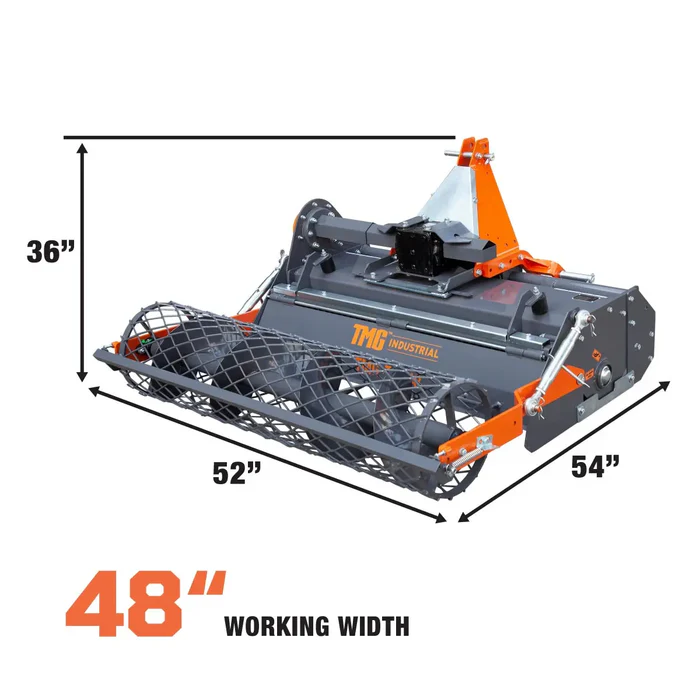
For facility managers overseeing large properties, construction site preparation, or agricultural logistics operations, the quality of land conditioning directly impacts project outcomes. Whether establishing new storage yards, preparing seedbeds for erosion control, or maintaining equestrian surfaces, the challenge often lies in dealing with unwanted stones and debris in the soil. A specialized implement that combines deep tillage with stone burial offers a significant operational advantage, streamlining what is typically a multi-step process into a single, efficient pass.
The Strategic Importance of Effective Soil Conditioning
In industrial and logistics contexts, land is not just a base—it is a functional surface. For planned construction, it must be stable and level. For landscaping or agricultural buffers, it must support healthy vegetation. Soils laden with stones impede these goals. They damage equipment, hinder plant root growth, and create uneven, hazardous surfaces. Removing stones through picking or screening is labor-intensive and costly. A method that redistributes them below the root zone preserves the site’s utility without the expense of material haul-off.
Technical Overview and Core FunctionalityHow a Stone Burier Rotary Tiller Operates
A stone burier, also known as a rotary tiller with stone burial capability, is a tractor-mounted implement powered by the Power Take-Off (PTO) system. Its design differs from a standard rotary tiller. As the PTO drives the rotor, a set of heavy-duty, forged steel tines rotate at a speed that both cultivates the soil and propels stones, clods, and debris forward and downward. A key component is the rear-mounted, adjustable basket-style roller. This roller controls the working depth and firms the soil. The stones are forced under the roller by the tine action and are subsequently buried at a depth of several inches, while the finer, pulverized soil flows over the top, leaving a clean, level seedbed. This process effectively inverts the soil profile, placing stones and debris below the surface where they no longer interfere.
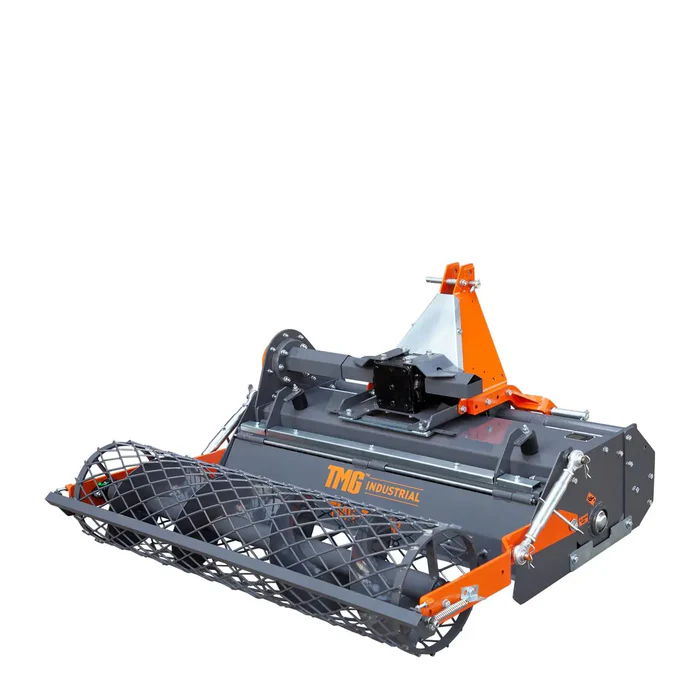
A unit like the 48″ Stone Burier Rotary Tiller is engineered for this demanding task. It features a robust chain-drive transmission on the side of the machine, which delivers power efficiently to the rotor shaft. The side-mount design also simplifies maintenance access compared to gearboxes housed within the main frame. The rotor itself is equipped with multiple flanges carrying a total of 24 replaceable tines, designed in left-hand and right-hand configurations to optimize soil flow and stone movement.
Key Specifications and Design Features
- Working Width and Depth: A 48-inch working width balances productivity with the power requirements of typical utility tractors. It achieves a tilling depth of 4-3/4 inches, sufficient for seedbed preparation and burying common stone sizes.
- Stone Burying Capacity: Engineered to handle stones up to 2-1/2 inches in diameter, pushing them down to a depth of up to 6 inches, well below the cultivated layer.
- Rotor and Tine Design: The rotor operates at 208 revolutions per minute (RPM), driven by a standard 540 RPM PTO input. The 24 forged steel tines are designed for high impact resistance, as they constantly strike stones and roots. Their replaceable nature is crucial for long-term serviceability.
- Hitch and Power Compatibility: Designed for Category 1, 3-point hitches and recommended for tractors in the 25 to 50 horsepower range. The included PTO driveline shaft simplifies attachment to the tractor.
- Finish and Durability: An architectural-grade powder-coated finish provides resistance to rust, corrosion, and abrasion from soil and stones, protecting the implement during use and storage.
- Adjustable PTO Mounting: The design allows for a horizontal offset of the PTO connection point. This feature enables the operator to position the tractor slightly offset from the implement, allowing it to work closer to obstacles like fence lines, building foundations, or trees.
The Critical Importance of Efficiency, Safety, and Productivity
The primary efficiency gain from a stone burier is the consolidation of operations. A single pass buries stones and cultivates the soil, eliminating the need for separate stone picking, hauling, and tilling. This directly translates to lower fuel consumption, reduced labor hours, and faster project completion. From a safety perspective, removing stones from the surface eliminates trip hazards and the risk of damage to subsequent machinery operating on the prepared ground, such as mowers or seeding equipment. The level, firm finish created by the rear roller also provides a safer, more stable surface for foot and vehicle traffic immediately after preparation.
Technical Foundations and Capability ConsiderationsPower Transmission and Soil Dynamics
The technical heart of the machine is its power train. The PTO shaft connects to a gearbox or, in this case, a side-mounted chain drive. The chain drive system is chosen for its shock absorption qualities; chains can handle the sudden, high-impact loads generated when tines strike large stones, reducing stress on the tractor’s PTO and the implement’s internal components. The rotor speed of 208 RPM is a calibrated balance—fast enough to lift and throw soil and stones, but slow enough to allow the material to separate effectively, with heavier stones being cast down and lighter soil flowing up and over the rear roller.
The Role of the Rear Roller
The rear basket roller is not just a finishing tool; it is integral to the stone burial process. By setting the roller height, the operator controls the depth of the tines. As soil and stones are thrown backward, they encounter the roller. The roller’s weight and design press the stones down into the void left by the tines, effectively burying them, while simultaneously smoothing and firming the surface soil. This creates a consolidated seedbed that resists erosion and retains moisture.
Factors Influencing Performance, Safety, and Effectiveness
Several variables determine the success of a stone-burying operation. Soil type is a primary factor; the implement works best in loamy or sandy soils that fracture easily. Heavy clay or extremely wet soils may ball up and not separate effectively, reducing stone burial efficiency. The density and size of stones are critical; the machine is designed for stones up to 2-1/2 inches. Larger rocks, over 5 inches as noted in guidelines, must be removed beforehand to prevent mechanical damage. Tractor power and setup are essential; insufficient horsepower will stall the rotor in heavy ground, while an improperly leveled 3-point hitch will result in uneven working depth. Operator technique, particularly ground speed (recommended 1 to 3 miles per hour), directly affects the quality of the finish. Moving too fast reduces tilling depth and stone burial effectiveness.
Safety Considerations and Industry Best Practices
Operating a PTO-driven implement with high-energy rotating tines requires strict adherence to safety protocols.
Essential Safety Protocols for Stone Burier Operation
- Pre-Operation Site Inspection: The area must be thoroughly walked to remove large obstacles such as wire, scrap metal, large rocks (over 5 inches), stumps, and logs that could damage the machine or become dangerous projectiles.
- Pre-Use Equipment Check: Inspect all tines for wear, damage, and secure mounting. Check the PTO driveline shield to ensure it rotates freely and is in place. Verify all safety shields on the chain drive and rotor are secured. Check bolt torque on critical components.
- Operational Safety: Ensure all bystanders, especially children and pets, are at a safe distance (at least 100 feet) from the operating area. Engage the PTO at low engine RPM and increase speed smoothly. Never attempt to clear a jam or make adjustments while the PTO is engaged or the tractor is running. Always disengage the PTO, shut down the tractor, remove the key, and wait for all rotating components to come to a complete stop before dismounting.
- Personal Protective Equipment: Operators should wear hearing protection, safety glasses, sturdy footwear, and close-fitting clothing to avoid entanglement with moving parts.
- Transport Safety: When raising the implement for transport, ensure it is securely latched and the PTO is disengaged. Be aware of the implement’s width and height when moving between fields or on public roads.
Equipment, Tools, and Supporting Attachments
The stone burier is the core tool, but successful integration requires compatible equipment:
- Tractor: A tractor in the 25-50 HP range with a Category 1, 3-point hitch and functional 540 RPM PTO. The tractor should have sufficient front ballast to maintain stability with the implement raised.
- Maintenance Tools: Basic tools for tine replacement and general bolt tightening, a grease gun for lubrication points, and spare tines for field replacement.
- Site Preparation Tools: A rock rake or similar may be needed for the initial removal of oversize debris as part of the pre-operation site inspection.
Advantages, Limitations, and Practical ApplicationStrategic Benefits and Operational Upsides
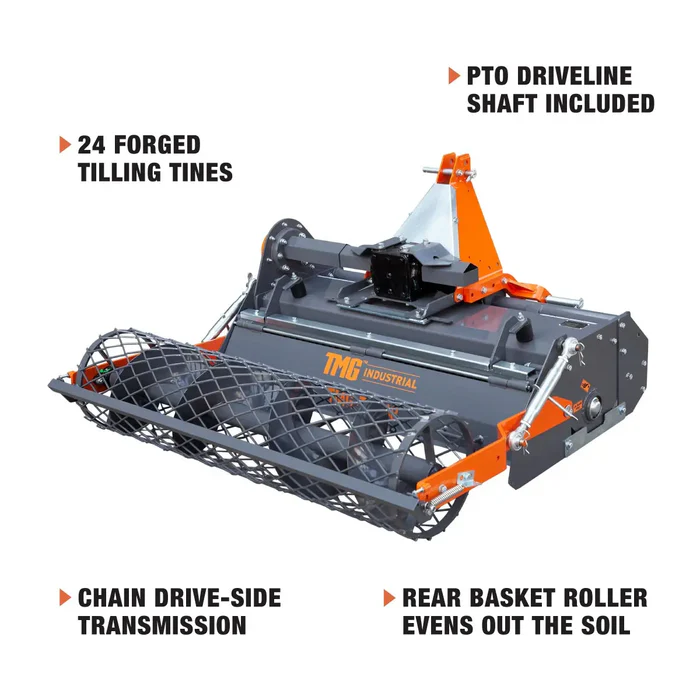
The primary advantage of a 48″ Stone Burier Rotary Tiller is its ability to create a stone-free, cultivated seedbed in a single pass, a task that would otherwise require multiple machines and significant labor. This consolidation saves time and fuel. By burying stones rather than removing them, it eliminates the cost of disposal and the need for importing clean fill. The level, firm finish left by the roller provides an ideal surface for planting or for subsequent construction activities like laying geotextile fabric or base aggregate. The ability to work close to obstacles, thanks to the offset PTO feature, maximizes usable land area.
Inherent Limitations to Consider
The implement’s effectiveness is limited by stone size and soil conditions. It is not suitable for sites with boulders or heavy concentrations of debris over 2-1/2 inches. It will not perform well in extremely rocky ground where stones are larger than its capacity. The working depth, while adequate for seedbeds, is not sufficient for deep subsoil preparation. The initial cost is higher than a standard rotary tiller, and the tines, being subject to high impact, are a wear item that will require periodic replacement depending on soil abrasiveness and stone content.
Real-World Industrial Application Example
A large equestrian facility and hay farm in the Mid-Atlantic region needed to convert several overgrown fields into new, high-quality pasture. The fields had been fallow for years and were littered with surface stones of various sizes, making them unsafe for horses and damaging to hay harvesting equipment. Using a tractor equipped with a stone burier, they were able to process each field in a single operation. The machine buried the stones, pulverized the soil clods, and left a smooth, firm seedbed. This eliminated the need for a contractor to screen and remove the stones, saving substantial cost. The prepared fields were immediately seeded and have since produced high-quality, stone-free pasture and hay.
Conclusion: Future Trends and Strategic Integration
The stone burier rotary tiller represents a specialized but highly effective solution for a common land preparation challenge. Its ability to combine cultivation and subsurface stone disposal streamlines operations, reduces costs, and improves final surface quality. Future trends in this equipment category will likely focus on even more durable tine metallurgy to extend wear life, improved rotor dynamics for better performance in varied soil types, and enhanced roller designs for more precise depth control and surface finishing. For procurement specialists and operations managers tasked with land development or large-scale site maintenance, evaluating a stone burier requires matching its capacity to the site’s specific soil and stone conditions. When correctly applied, it is a powerful tool for transforming challenging ground into productive, safe, and usable land.
