

Introduction
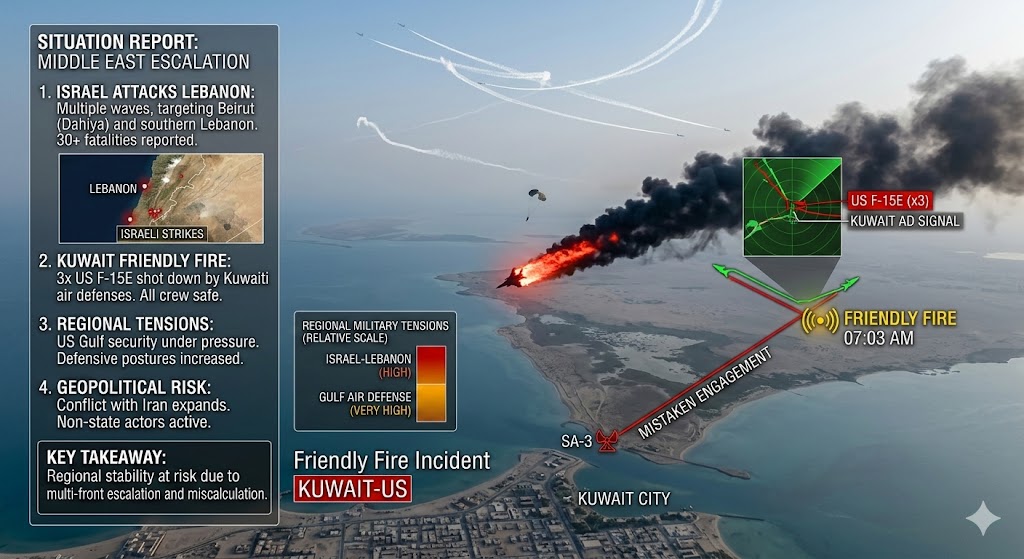
When reports emerge that Israel attacks Lebanon, Kuwait mistakenly shoots down US jets, the immediate reaction is concern over whether a contained confrontation could spiral into a broader regional conflict. Such developments are not isolated incidents. They sit within a complex web of historical tensions, military alliances, air defense systems, and fragile diplomatic balances across the Middle East.
Understanding what these events mean requires more than headline-level awareness. It demands context. Why would Israel strike targets in Lebanon? How could Kuwait mistakenly engage US aircraft? What does this signal about regional coordination, military protocols, and escalation risk?
This article provides a structured, long-term geopolitical analysis of these developments, examining the background, strategic mechanics, institutional context, risks, and future implications for global security.
Clear Definition of the Situation
The phrase “Israel attacks Lebanon, Kuwait mistakenly shoots down US jets” combines two separate but potentially interconnected security incidents:
- Cross-border military action involving Israel and Lebanon.
- A friendly-fire or misidentification incident involving Kuwait and aircraft belonging to the United States.
What It Implies
Such incidents typically indicate:
- Heightened regional military alert levels
- Airspace congestion and overlapping operations
- Potential breakdowns in communication protocols
- Escalation risk involving allied states
When multiple militaries operate simultaneously in volatile regions, the risk of miscalculation increases significantly.
Background and Historical Context
Israel–Lebanon Conflict Dynamics
Tensions between Israel and Lebanon have existed for decades, particularly involving non-state armed groups operating from southern Lebanon. Historically, cross-border strikes have occurred in response to rocket fire, militia activity, or perceived security threats.
The 2006 conflict between Israel and Hezbollah reshaped regional military doctrine. Since then:
- Israel has conducted targeted strikes aimed at preventing weapons transfers or militant entrenchment.
- Lebanon’s internal political landscape has remained fragmented.
- Border areas have remained sensitive flashpoints.
Kuwait’s Security Role
Kuwait is a strategic Gulf state hosting US military assets as part of broader regional security cooperation. It plays a key role in:
- Gulf security coordination
- Airspace monitoring
- Coalition operations
Friendly-fire incidents, while rare, typically occur during periods of elevated threat perception when air defense systems are placed on high alert.
Regional Security Architecture
The Middle East contains overlapping military operations involving:
- US forces
- Regional allies
- Non-state actors
- International maritime security patrols
This complexity increases the likelihood of misidentification in tense scenarios.
Strategic Mechanisms Behind Escalation
Understanding how Israel attacks Lebanon and Kuwait mistakenly shoots down US jets requires examining military and diplomatic mechanics.
1. Airspace Deconfliction Failures
Modern conflict zones rely on airspace coordination systems designed to prevent allied forces from engaging one another. These systems depend on:
- Identification Friend or Foe (IFF) signals
- Real-time radar tracking
- Command-center communication
- Coalition data-sharing
If any layer fails due to technical error or misinterpretation, friendly fire can occur.
2. Preemptive Strike Doctrine
Israel has historically maintained a doctrine of preemptive or preventive action against perceived threats along its borders. This includes:
- Airstrikes on suspected weapons depots
- Targeted operations against militant infrastructure
- Deterrence messaging
Such actions are often framed as defensive measures but can trigger retaliatory responses.
3. High Alert Status and Miscalculation
When one state increases military activity, neighboring states may elevate alert levels. Elevated readiness often means:
- Faster engagement decisions
- Reduced response time
- Greater reliance on automated defense systems
This environment increases the chance of accidental engagements.
Institutional and Global Context
United Nations Framework
The United Nations maintains peacekeeping forces in southern Lebanon under UNIFIL (United Nations Interim Force in Lebanon). Their mandate includes:
- Monitoring ceasefire lines
- Reporting violations
- Supporting stability
However, peacekeeping forces are limited in enforcement capability.
Energy and Trade Considerations
The Middle East remains critical to:
- Global oil supply chains
- Maritime trade routes
- Strategic chokepoints such as the Strait of Hormuz
Any escalation involving Israel, Lebanon, Kuwait, or US forces affects energy market stability and investor confidence.
US Strategic Presence
The United States maintains military installations across the Gulf region for deterrence, logistics, and regional security cooperation. Incidents involving US aircraft may:
- Strain diplomatic relations
- Trigger internal investigations
- Prompt reevaluation of operational protocols
Strategic Advantages of Diplomatic Containment
Even amid escalation, states often seek containment. Diplomatic engagement offers several advantages:
- Prevents rapid regional spillover
- Reassures financial markets
- Maintains alliance stability
- Protects civilian air traffic corridors
- Reduces miscalculation risk
Swift clarification following a friendly-fire incident can prevent long-term diplomatic damage.
Risks and Criticism
Escalation Risk
When Israel attacks Lebanon, retaliation risk increases. This can expand into:
- Broader border clashes
- Missile exchanges
- Cyber or asymmetric responses
Alliance Strain
If Kuwait mistakenly shoots down US jets, even accidentally, it may raise concerns regarding:
- Command coordination
- Joint training standards
- Interoperability of defense systems
Civilian Impact
Military escalation near populated areas risks:
- Infrastructure damage
- Refugee displacement
- Economic disruption
International Legal Concerns
Cross-border strikes raise questions regarding:
- Sovereignty
- Proportionality
- International humanitarian law
Balanced analysis must acknowledge that interpretations differ widely depending on political perspective.
Real-World Implications
Impact on Global Markets
Geopolitical instability in the Middle East often affects:
- Oil futures pricing
- Shipping insurance costs
- Currency fluctuations
Investors respond quickly to perceived regional instability.
Regional Military Readiness
Such incidents may prompt:
- Expanded air defense exercises
- Joint investigation committees
- Revised engagement rules
Diplomatic Realignment
States in Europe and Asia, heavily dependent on Middle Eastern energy, may increase diplomatic engagement to prevent escalation.
Comparative Perspective
Israel’s Security Approach vs Gulf Defense Posture
Israel emphasizes rapid preemptive action to neutralize threats. Gulf states often focus on:
- Defensive airspace monitoring
- Coalition coordination
- Strategic hosting of allied forces
These differing doctrines sometimes create friction during high-alert periods.
Direct Intervention vs Strategic Deterrence
Some states rely on forward military presence, while others depend on deterrence through technological superiority and intelligence capabilities. Incidents like mistaken shootdowns highlight the fragility of coordinated defense systems.
Future Outlook
Several scenarios could unfold following events such as Israel attacks Lebanon, Kuwait mistakenly shoots down US jets:
- Diplomatic Containment
Rapid clarification and de-escalation prevent further conflict. - Limited Retaliation
Controlled military responses signal deterrence without broad escalation. - Prolonged Tension
Increased patrols and alert levels persist for months. - Broader Regional Spillover
Additional actors become involved, expanding the theater of instability.
The most probable outcome historically has been containment after initial tension. However, unpredictability remains a defining feature of regional geopolitics.
Frequently Asked Questions
1. Why would Israel attack Lebanon?
Israel typically frames cross-border operations as defensive responses to security threats, including militant activity or weapons transfers.
2. How can a country mistakenly shoot down allied aircraft?
Friendly-fire incidents often result from misidentification, radar misinterpretation, or communication breakdown during high-alert operations.
3. What role does the United Nations play in Lebanon?
The United Nations monitors ceasefire lines and deploys peacekeeping forces, though it does not enforce military outcomes.
4. Could this trigger a wider Middle East war?
While escalation risk exists, diplomatic containment mechanisms often limit broader conflict.
5. How does this affect global energy markets?
Middle Eastern instability can influence oil prices, shipping routes, and investor confidence globally.
Conclusion
When reports state that Israel attacks Lebanon, Kuwait mistakenly shoots down US jets, the implications extend far beyond the immediate battlefield. These incidents reflect the fragility of regional security coordination, the complexity of air defense operations, and the persistent volatility of Middle Eastern geopolitics.
While escalation risks are real, historical precedent suggests that diplomatic containment and institutional coordination often prevent broader war. Still, such developments reinforce a critical reality: in regions where multiple military actors operate simultaneously, the margin for error remains narrow.
Understanding these events requires structural awareness, not reactive interpretation. The long-term significance lies not only in the incident itself but in what it reveals about regional deterrence, alliance coordination, and the evolving balance of global power.
