

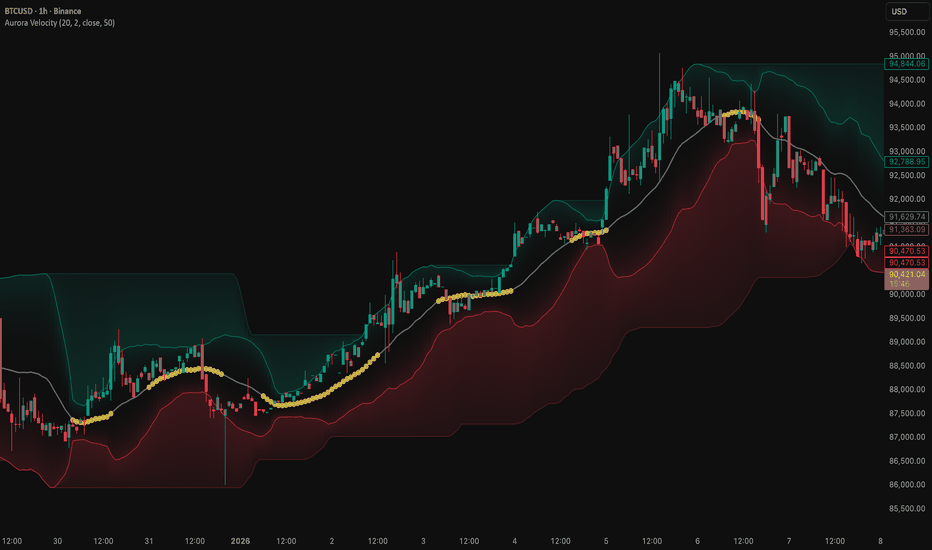
In today’s highly information-driven financial markets, one of the biggest challenges traders face is not “whether there are opportunities,” but rather “how to quickly form effective judgments from a vast amount of information.” Whether it’s stocks, forex, or crypto assets, market changes are often fleeting, which makes chart analysis tools increasingly important in actual trading. Among numerous analysis platforms, TradingView has gradually become a core tool for many traders in their daily market research.
From “watching market trends” to “understanding market trends”
Many beginners, when starting out in trading, often only focus on price fluctuations, neglecting a comprehensive assessment of trends, market structure, and market sentiment. The true value of TradingView lies not just in displaying prices, but in its ability to help traders understand what’s happening in the market through visualization.
In real-world trading scenarios, traders often need to observe multiple timeframes simultaneously. For example, daily charts are used to determine medium- to long-term trends, hourly charts are used to find entry points, and minute-level charts are used for more precise execution. TradingView’s multi-timeframe switching and synchronization capabilities make this analysis process smoother and more aligned with the thinking of professional traders.
The Practical Significance of Technical Indicators
More technical indicators are not necessarily better; they should serve the trading logic. In practice, many traders build their systems around a few core indicators, such as moving averages, RSI, or MACD. TradingView offers a wide range of indicators and allows users to adjust parameters according to their strategies.
More importantly, traders can overlay multiple indicators on the same chart to observe their performance under different market conditions. This intuitive comparison helps determine whether a signal is valuable, rather than mechanically “placing an order upon seeing a signal.”
Market analysis is more than just personal judgment.
In real markets, trading is not an isolated activity. The views, emotions, and expectations of different traders often influence price movements. TradingView’s community features provide an additional dimension to market analysis.
By browsing charts and analyses posted by other traders, users can understand the prevailing opinions and points of disagreement in the current market. This doesn’t mean blindly following, but rather helping traders realize that when most people are bullish or bearish, risk may be quietly accumulating. For rational traders, this “market consensus perception” is extremely valuable in practical decision-making.
The Real Need for Multi-Market Analysis
With the diversification of trading instruments, more and more traders are no longer confined to a single market. For example, some use the US dollar index to help predict gold price movements, while others use Bitcoin price charts to gauge overall risk appetite. TradingView’s performance in integrating multi-asset charts makes cross-market analysis more efficient.
In actual trading, this kind of correlation analysis can often identify potential opportunities or risks in advance. For example, when related markets show divergence, it often means that the trend may be changing. This kind of information is difficult to capture in a timely manner using only a single market data software.
From tools to trading habits
For long-term market participants, the value of a tool ultimately lies in its integration into their daily analysis workflow. TradingView’s cross-device synchronization allows traders to conduct in-depth analysis on their computers and view key price levels and trend changes anytime on their mobile devices. This continuity helps cultivate stable trading habits, rather than making fragmented, emotional decisions.
If you wish to gain a deeper understanding of how these chart analysis tools are applied in real-world market environments, you can refer to TradingView ‘s content to re-examine the role of charts in trading from the perspective of analytical logic rather than trading results.
Conclusion
In real trading, no tool can guarantee profits, but a suitable analysis platform can significantly improve the quality of judgment. TradingView’s practicality lies not in its ability to “predict the market,” but in its ability to help traders observe the market more systematically, verify hypotheses, and gradually develop their own analytical framework. For traders who value the process rather than short-term results, this is precisely the fundamental capability needed for long-term market participation.
